


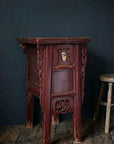
Antique Chinese Flower Side Table
$475.00
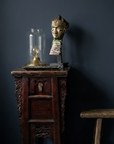
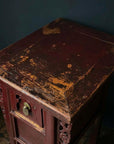
Ancient garnet lacquer, worn to amber at the edges. This piece carries two centuries of domestic life, use and love. Against a wall, beside a bed, in an entryway, it quietly sits emanating beauty and groundedness while lives and worlds revolve around it.
With its prior use being a small corner of sacred intention and prayer, mixed with utility, it can now bring that to your space.
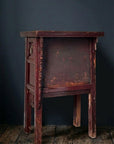
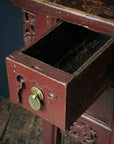
The single drawer holds what you want tucked away. The carved apron and open lower shelf are for what you want visible — books, a vessel, a candle. The original brass coin-pull is still on the drawer. The joinery is still tight. It functions as well today as it ever did, even 250 years ago.
The patina where the lacquer has worn through to the elm beneath is part of the piece. It should stay exactly as it is.
-- History & Provenance --
This cabinet dates to the Qing dynasty (1644–1912), most likely produced in Fujian Province in southern China during the 18th or early 19th century. Fujian was one of China's primary furniture-making regions during this period, with a tradition of skilled joinery and strong trade connections throughout Southeast Asia.
Cabinets of this form — compact, high-legged, with a single drawer and carved apron panels — were made for domestic interiors. They sat beside beds or household altars, holding incense, personal objects, whatever a person kept within reach. They were built for private life.
The construction is traditional mortise-and-tenon joinery throughout, with no nails. The floating panel top was designed to move with the wood across seasons, which is why the piece remains structurally intact after two centuries. The openwork carving on the apron panels features peony and lotus motifs — both auspicious in Chinese decorative tradition, the peony associated with prosperity, the lotus with spiritual purity.
The finish is lacquer over elm. The deep red was a deliberate choice: in Chinese culture the color carries associations with vitality and good fortune, fitting for a piece meant to hold a meaningful place in the home.
---
Period: Qing Dynasty, 18th–19th c.
Origin: Fujian Province, China
Material: Elm, lacquer, brass
Construction: Traditional mortise and tenon
Hardware: Original brass coin-pull, intact
Condition: Naturally patinated, structurally sound
Height: 31”
Width: 16.5”
Diameter: 20”
With its prior use being a small corner of sacred intention and prayer, mixed with utility, it can now bring that to your space.
The single drawer holds what you want tucked away. The carved apron and open lower shelf are for what you want visible — books, a vessel, a candle. The original brass coin-pull is still on the drawer. The joinery is still tight. It functions as well today as it ever did, even 250 years ago.
The patina where the lacquer has worn through to the elm beneath is part of the piece. It should stay exactly as it is.
-- History & Provenance --
This cabinet dates to the Qing dynasty (1644–1912), most likely produced in Fujian Province in southern China during the 18th or early 19th century. Fujian was one of China's primary furniture-making regions during this period, with a tradition of skilled joinery and strong trade connections throughout Southeast Asia.
Cabinets of this form — compact, high-legged, with a single drawer and carved apron panels — were made for domestic interiors. They sat beside beds or household altars, holding incense, personal objects, whatever a person kept within reach. They were built for private life.
The construction is traditional mortise-and-tenon joinery throughout, with no nails. The floating panel top was designed to move with the wood across seasons, which is why the piece remains structurally intact after two centuries. The openwork carving on the apron panels features peony and lotus motifs — both auspicious in Chinese decorative tradition, the peony associated with prosperity, the lotus with spiritual purity.
The finish is lacquer over elm. The deep red was a deliberate choice: in Chinese culture the color carries associations with vitality and good fortune, fitting for a piece meant to hold a meaningful place in the home.
---
Period: Qing Dynasty, 18th–19th c.
Origin: Fujian Province, China
Material: Elm, lacquer, brass
Construction: Traditional mortise and tenon
Hardware: Original brass coin-pull, intact
Condition: Naturally patinated, structurally sound
Height: 31”
Width: 16.5”
Diameter: 20”